
According to the State University System (SUS), more than 30,000 international students from over 200 countries are enrolled across its campuses. These students contribute both directly and indirectly to their institutions. The SUS has identified increasing STEM degree production as a key priority in its 2025 System Strategic Plan, and international students are playing a significant role in helping the system reach this goal by pursuing and completing degrees in high-demand STEM fields.
This report analyzes international student enrollment by country of origin and degree completion trends in Florida’s SUS with a focus on STEM fields. STEM fields are defined using the U.S. Department of Homeland Security’s Designated Degree Program List. Degrees in these fields qualify F-1 visa holders for a 24-month Optional Practical Training (OPT) extension beyond the initial post-completion OPT, allowing them up to 36 months of work authorization after completing all degree requirements for an undergraduate degree or, for graduate students, after completing all requirements except their thesis/dissertation. This benefit to international students allows them to gain practical work experience directly related to their degree, meeting the state’s workforce needs.
To better understand how international enrollment has changed over time, the FCAN research team examined data from SEVIS – a web-based system managed by the U.S. Department of Homeland Security. This analysis focuses on trends in the number of active SEVIS records at Florida institutions from 2014 to 2022, reflecting students on F-1 (academic) and M-1 (vocational) visas.
Click on the visualization below to explore how Florida’s international student population has changed over time by the top ten countries of origin.
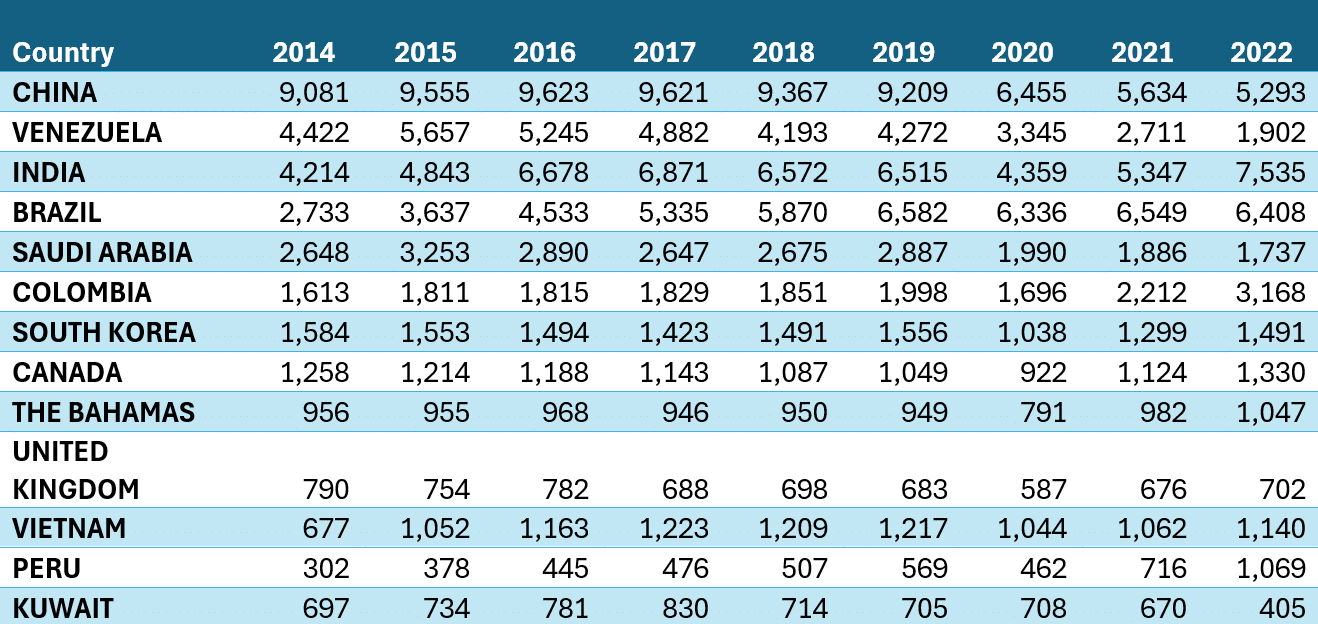
A summary of the number of international students by selected country of origin can be seen in Table 1.
Table 1: International Students by Country of Origin, 2014-2022
 Source: SEVIS
While these data highlight shifting patterns in the origin of Florida’s international students, additional insight emerges when examining degree completions by level. The following analysis focuses on undergraduate and graduate degrees awarded to nonresident alien* (see note) in Florida’s SUS between 2018-19 and 2023-24 and can be seen in Figure 1.
Figure 1: Number of Undergraduate and Graduate Degrees Awarded to International Students at SUS Institutions
 Source: NCES
Note: *The National Center for Education Statistics (NCES) defines a nonresident alien as an individual who is not a U.S. citizen or national and who does not meet the criteria for being classified as a resident alien for tax purposes. Throughout this report, the term “international students” refers broadly to individuals from non-U.S. countries who are studying in Florida.
From 2018-19 to 2023-24, both undergraduate and graduate degree completions by international students in Florida’s SUS showed overall growth, with graduate degrees consistently outpacing undergraduate degrees. Undergraduate completions rose steadily each year, increasing from 2,249 in 2018-19 to 3,169 in 2023-24 marking a growth of 29%. Graduate degree completions showed more fluctuation. After a decline from 3,769 in 2018-19 to 3,074 in 2021-22, likely due to the impact of the COVID-19 pandemic, graduate degrees rebounded sharply in the following years, reaching a peak of 4,787 in 2023-24. This represents a growth of 27% across the six-year period. The data suggest strong and growing international student participation at both degree levels, with particularly notable recent gains in graduate education. A more detailed look (see Figure 2) at completions by specific degree levels offers further insight into how international student engagement varies across undergraduate and graduate pathways at SUS institutions.
Figure 2: Number of Degrees by Type Awarded to International Students at SUS Institutions, 2018-19 to 2023-24
 Source: NCES
Between 2018-19 and 2023-24, international student degree completions in Florida’s SUS show distinct trends by degree level. Master’s degrees, while representing the highest volume of completions in most years, displayed greater fluctuation. After a decline to 2,174 in 2021-22, which is likely reflecting the impacts of the COVID-19 pandemic, master’s completions rebounded significantly, reaching 3,957 in 2023-24, the highest level over this period. Research doctorates remained relatively stable, with annual counts ranging from 756 to 882. In contrast, professional doctorates had low and inconsistent completions, with figures ranging from just 15 to 39 over the six-year period.
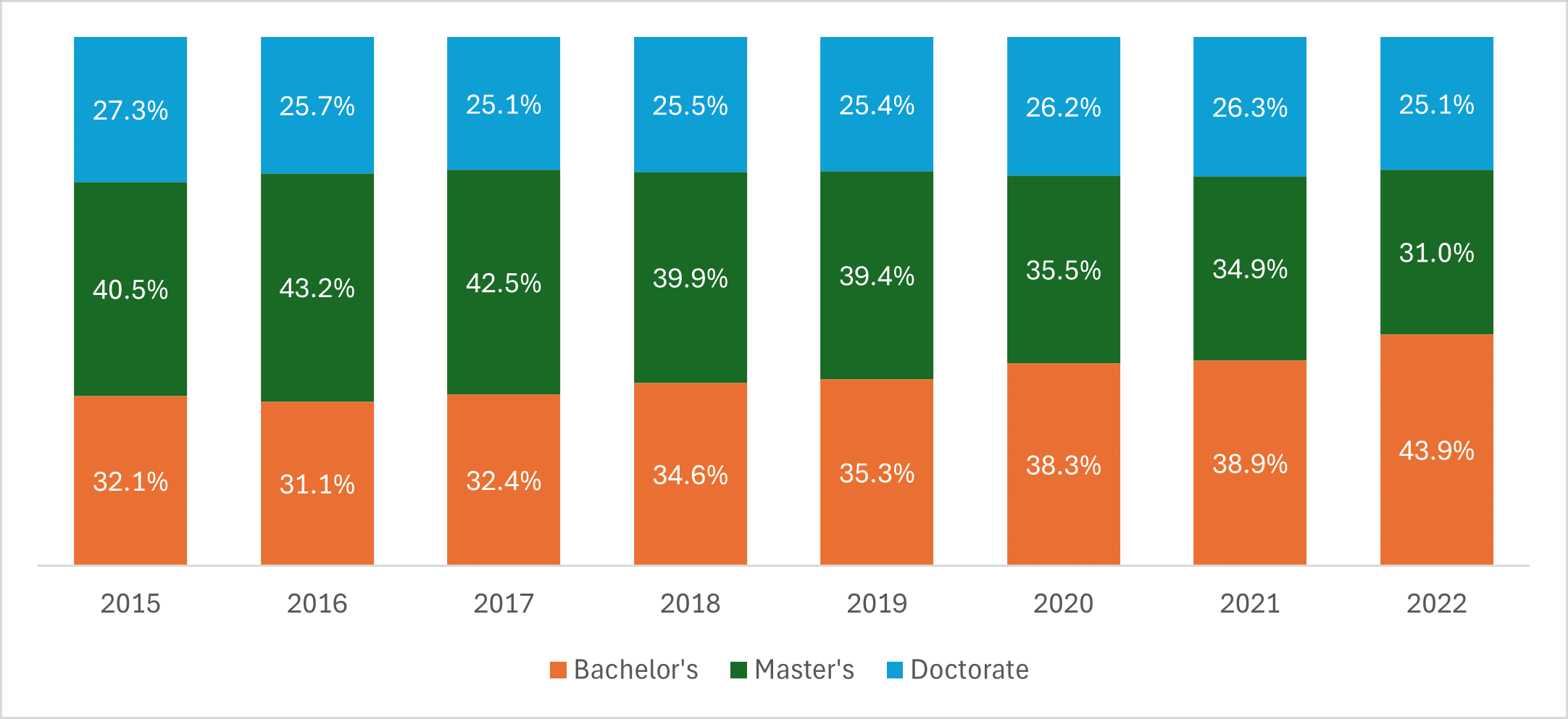
Building on these overall degree completion patterns, a closer look at the share of international students earning degrees in STEM fields reveals additional insights into the academic interests across degree levels as is depicted in Figure 3. From 2015 to 2022, the share of STEM degrees earned by international students at the bachelor’s level increased steadily, rising from 31.1% in 2016 to 43.9% in 2022. In contrast, master’s-level STEM degrees declined over the same period, dropping from 43.2% in 2016 to 31.0% in 2022. Meanwhile, the share of STEM doctorates remained relatively stable, fluctuating only slightly between 25.1% and 27.3%.
Figure 3: Statewide Share of International STEM Degrees Awarded, 2015-2022
 Source: SEVIS
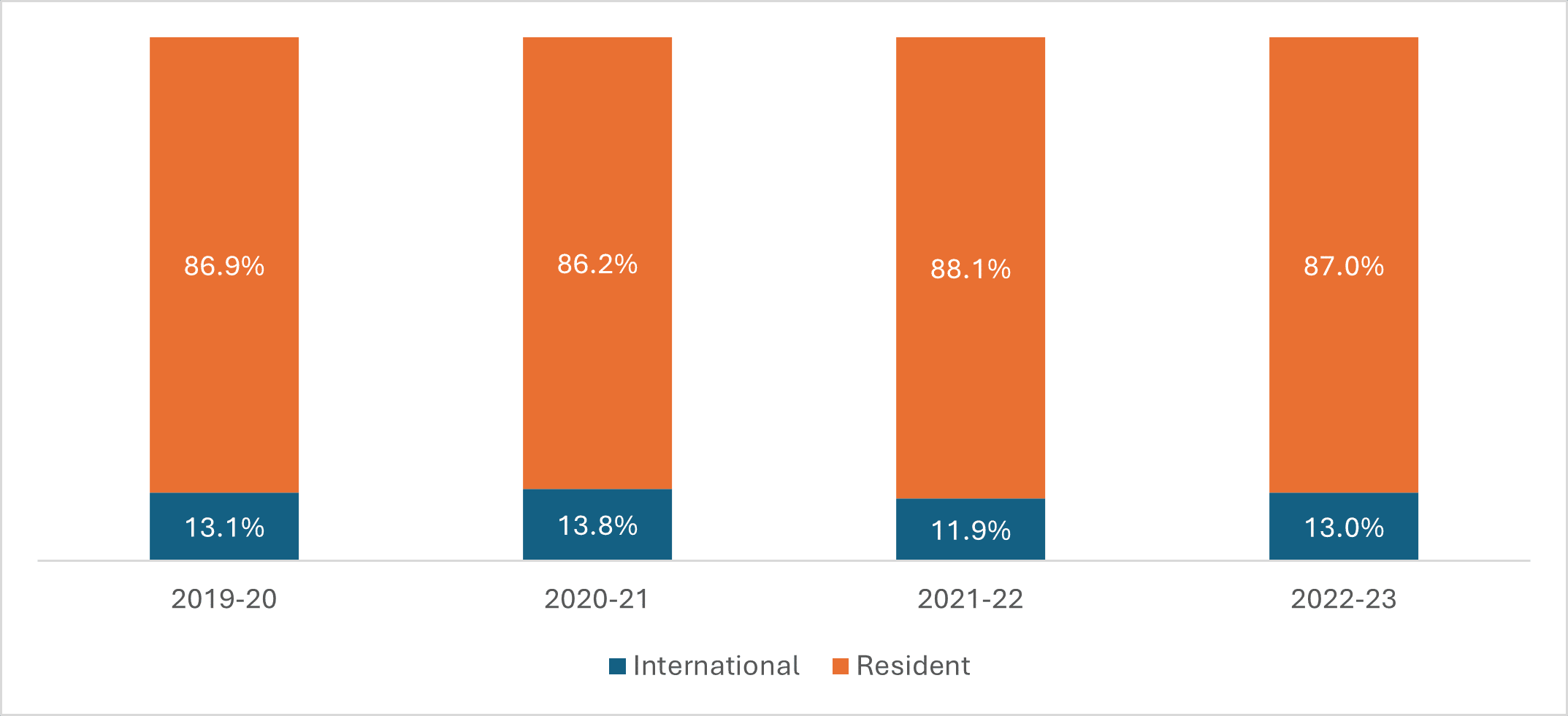
While these trends illustrate shifting academic preferences among international students by degree level, a broader view of STEM degree completions reveals the sustained role international students continue to play in Florida’s STEM talent pipeline. The data in Figure 4 show that the share of international students earning STEM degrees has remained relatively stable, hovering between 12% and 14% of all STEM degrees awarded between 2019-20 and 2022-23.
Figure 4: Share of STEM Degree Completions by Residency, 2019-20 to 2022-23, SUS Institutions
 Source: NCES
Key takeaways from this analysis:
- While China once led in sending international students, India became the top source by 2022, reflecting global trends and U.S. immigration policy changes including stricter visa vetting following a June 2020 executive order that reduced F-1 visa issuances, especially for graduate students.
- Degree completions among international students in Florida’s SUS institutions increased overall, both at the undergraduate and master’s levels.
- While the share of international students earning STEM bachelor’s degrees at Florida’s SUS institutions increased between 2016 and 2022, the share of STEM master’s degrees earned by international students at those same institutions declined during this period.
International student enrollment in Florida’s SUS institutions continues to evolve. The overall increases in degree completions as well as the growth in the shares of international students earning STEM bachelor’s degrees suggest that international graduates are contributing to Florida’s degree attainment goals and expanding its talent pipeline in high-demand fields.