
Postsecondary
Enrollment Heatmap
Postsecondary
Enrollment
FCS/SUS
Graduation Rate
FCS/SUS
Enrollment Status
Postsecondary Enrollment Heatmap
Postsecondary continuation rates reflect the share of students who enroll in Florida public postsecondary education programs within one year of high school graduation. Pursuing a postsecondary pathway is important as 72% of jobs will require education beyond high school by 2031. Floridians who attend college are more likely to enjoy increased lifetime earnings and more economic opportunities than their fellow residents who end their education after high school. The latest available data shows Florida’s postsecondary enrollment rate is 54.2%.
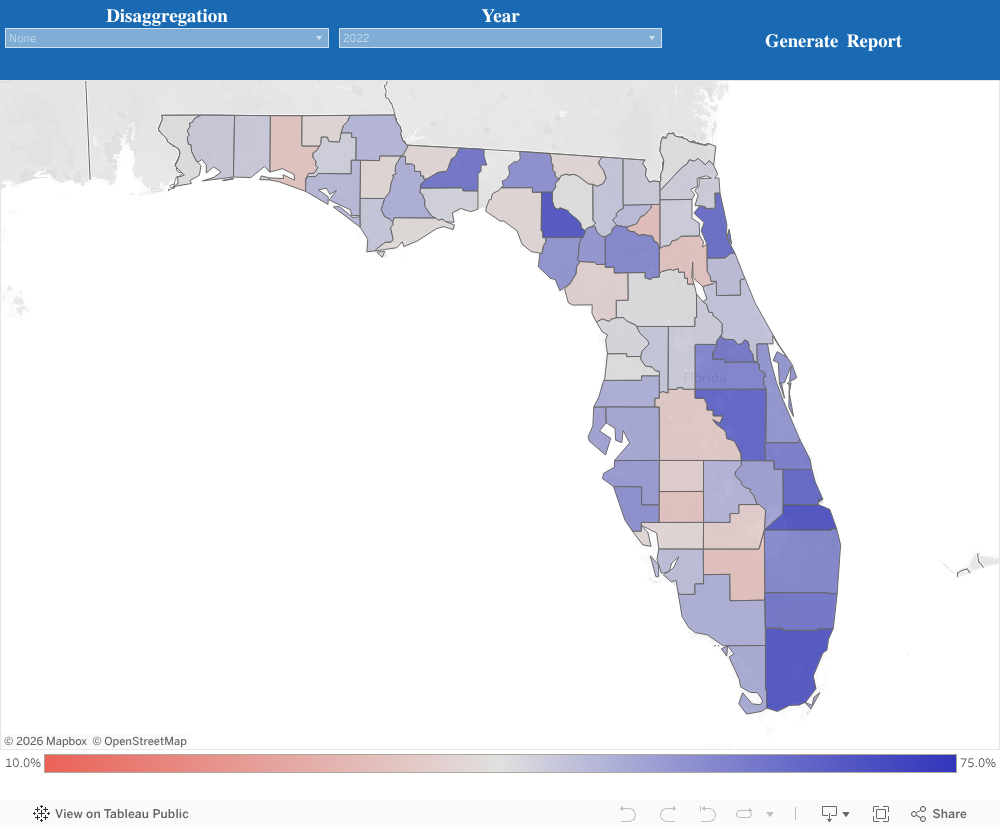
Postsecondary Enrollment
Race/Ethnicity: Highlighting trends in postsecondary continuation rates by race/ethnicity is important to identify opportunities for closing gaps among underrepresented student groups with the goal of improving educational outcomes for all students.
Sex: Understanding patterns in postsecondary enrollment by sex is key to improving outcomes for all students. Within 12 months of graduating high school, 60.5% of Florida’s female graduates and 47.8% of male graduates enrolled in one of the state’s postsecondary institutions or a district technical college.
Economic Status: Examining postsecondary education trends by income level is important because students from low-income backgrounds often face financial barriers that limit access to higher education. Expanding college participation is key to economic mobility. Increasing Florida’s enrollment rate by just 10% could yield an estimated $8.38 billion annually for the state.

FCS/SUS Graduation Rate
Cohort graduation rate captures institutional productivity, representing the number of first-time, full-time degree seeking students of a cohort completing their degree program within 150% of normal time (4-year institution = 6 years; 2-year institution = 3 years).
From 2019-2022, the aggregate FCS graduation rate for the full cohort rose from 39% to 42%; the SUS graduation rate over the same evaluation period rose from 59% to 65%. Use the filters in the toolbar to isolate groups and view trends for specific characteristics.

FCS/SUS Enrollment Status
The 28 Florida College System and 12 State University System institutions offer Floridian residents a range of affordable and high-quality education pathways. Affordable tuition and ample post-graduate opportunities across the state have rendered Florida’s postsecondary system an attractive destination for out-of-state students.
Enrollment trends reflect talent choosing to remain in the state to pursue postsecondary education and potentially enter Florida’s workforce pool. At the FCS level, in-state enrollment shares remained relatively stable from 2018-2022, falling only 1.8 percentage points from 94.8% to 93.2%. For SUS students, in-state shares have seen a slightly more dramatic drop, from 89.4% to 84.2%.
