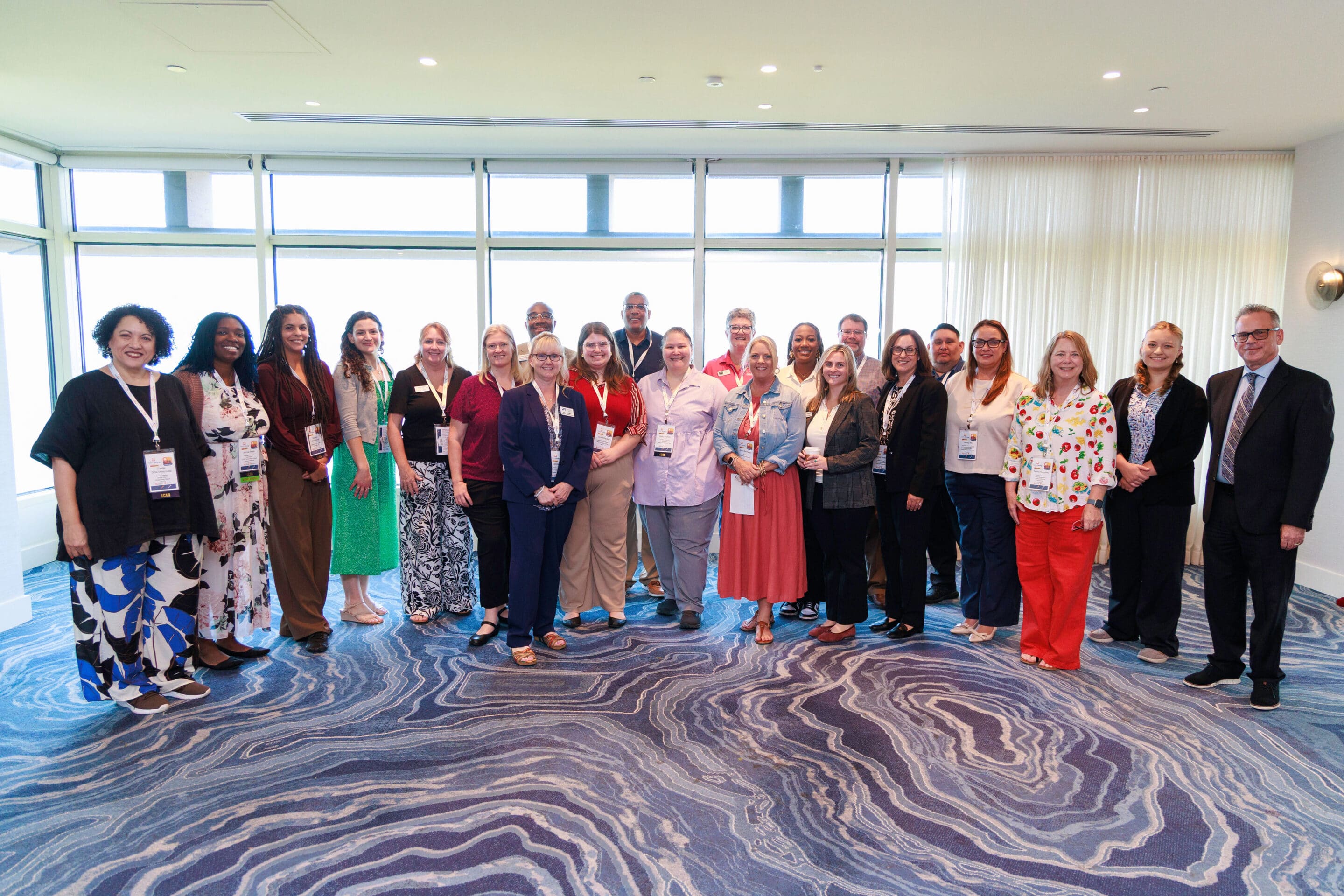
LCAN leaders at the 2026 Talent Strong Florida Summit.
A Local College Access Network is what happens when the leaders in a community who care about getting students to and through college stop working in parallel and start working in concert. Schools, employers, nonprofits, financial aid experts, families, all of them pulling toward the same goal, with someone whose job is to keep them aligned.
That alignment is hard to build and even harder to sustain. This past year, FCAN built LCAN 101 to help.
LCAN 101 is an eight-session capacity-building series designed for leaders of Local College Access Networks at every stage of development.
It rests on one premise: no organization, however well run, can move a county’s attainment rate on its own. But LCANs can, especially when the leaders who hold those networks together have tools, peers, and the persistence to keep at it.
The Eight Sessions
 Session 1: The opening session establishes the core argument of the series and the essential role and value of a Local College Access Network. The session traces what separates networks that stall from those that build toward systems and population-level change. TOOLS
Session 2: The second session offers five research-grounded foundations: shared purpose, mutual value, consistent presence, low-friction engagement, and co-creation rather than extraction. Two tools support Session 2: a Network Map assesses who is at the table and who is missing, and a Do One Thing action planner offers concrete next steps a network can take. TOOLS
Session 3: The third session draws a clear line between outputs, which are countable, and outcomes, which are measurable. We introduce the concept of a North Star metric. Every strategy decision, partnership conversation, and funding ask should filter through a single question: will this move our North Star? It also covers the data visualization principles that make the difference between a chart that informs and one that obscures, drawing on the work of Stephanie Evergreen and Ann Emery. TOOLS
Session 4: LCANs are operating in a volatile environment. Smart strategy means distributing leadership so no single champion carries the weight; diversifying resources so no single funder is more than half your revenue; and building adaptive strategies so your direction (North Star) stays fixed even if your tactics need to flex. TOOLS
Session 5: Most networks form around convenience and existing relationships. Does your LCAN table reflect the community you serve? How connected are your partners to each other? Does your network reach across the boundaries that matter most for students? LCANs should think of themselves as bridging institutions; the density and diversity of each LCAN partner table directly determine whether students gain access to the relationships proven to change economic trajectories. The StriveTogether Postsecondary Completion Playbook’s five domains gave participants a mapping tool: for each domain essential to college access and success, who in your community owns that function, and are they at your table? TOOLS
Session 6: Tools and resources that backbone leaders need to function well are covered in this session, including FCAN’s State of College Access Dashboard and Florida FAFSA Challenge Dashboard and a Partner Tracker developed just for LCANs. The session also covers AI tools, including what they do well for backbone leaders working alone with a lot of plates in the air, and where human judgment is irreplaceable. TOOLS
Session 7: The question underneath this session: What makes this work permanent? Fundable and permanent are not the same thing. Fundable means someone gave you money. Permanent means the community decided the public library is essential, the way they decided the library is essential. The session works through a four-function budget framework: building access infrastructure, convening and relationship management, data and public engagement, and fund development. The LCAN Self-Assessment Tool, developed in collaboration with Research for Action, is introduced as both a growth instrument and a case-making exercise. TOOLS
Session 8: The final session asks perhaps the hardest question of the series: What, exactly, are you accountable for? A theory of change holds together a Local College Access Network because it forces you to name who you serve and where, what you commit to moving, and how you believe change actually happens, including what you will not do. LCANs without a theory of change are dependent on the people at the table believing in the work. LCANs with one are dependent on the community believing in the goal. The second condition survives leadership turnover, funder shifts, and political pressure. The first does not. A theory of change and intended impact toolkit provides next steps on how to have these conversations back at home. TOOLS
What the Series Built

For FCAN, the series has produced a codified model of LCAN development support, now embedded in our technical assistance infrastructure alongside the LCAN Self-Assessment Tool developed with Research for Action. The two instruments reinforce each other. The series builds knowledge and skills. The assessment maps where a network is and where it needs to go.
The peer relationships formed across the cohort also matter. Local network directors hold a unique function in their community, serving as the only person in their county whose full-time job is convening partners around college access. LCAN 101 built connections across the state with local directors, eliminating isolation and opening the lines of communication.
A Talent Strong Florida, one where 60 percent of working-age residents hold a high-value postsecondary credential by 2030, will be built through community-based networks made up of leaders that know how to build shared purpose, use data, sustain partners, survive disruption, and hold themselves accountable to population-level outcomes over time. LCAN 101 is where that work starts.
- LCAN 101 playlist on YouTube
- Companion Dropbox
LCAN 101 was supported by Helios Education Foundation. For information on starting a Local College Access Network in your community, contact FCAN at fcan@floridacollegeaccess.org.