
This week is National AmeriCorps Week — a moment to recognize the Americans who serve their communities through one of the country’s most flexible federal service programs. Some Florida organizations are already using AmeriCorps to connect students to college. More could.
AmeriCorps is a federal agency that engages Americans in service through a variety of programs. More than 200,000 AmeriCorps members and volunteers serve each year. While AmeriCorps supports work across many sectors, from public health and disaster response to environmental conservation, one of its programs has a direct connection to college access: AmeriCorps State and National, which funds organizations that place members to meet community needs in education, among other areas.
Because AmeriCorps represents a significant and underutilized resource for organizations working to increase postsecondary attainment, FCAN is taking a closer look at how it works and where it is already being used in Florida. To learn more about the AmeriCorps programs, how they are funded, and recent federal developments affecting them, read our companion resource, AmeriCorps in Florida: An Overview.
Through AmeriCorps State and National, organizations can receive grants to recruit, train, and place AmeriCorps members in direct service and capacity-building roles. Members serve approximately 1,700 hours over 11 months. In exchange, they receive a living allowance, health insurance, childcare assistance, and an education award of up to the maximum Pell Grant amount per year of service. This can be applied toward tuition or used to pay down existing student loans.
In Florida, most AmeriCorps funding flows through Volunteer Florida, the governor-appointed state service commission, which runs annual grant competitions and awards subgrants to organizations statewide. Between 1994 and 2023, more than 43,000 Florida residents served approximately 62 million hours through AmeriCorps programs and earned education awards totaling more than $147 million. In 2023 alone, the federal AmeriCorps program invested more than $45 million in Florida, and its partners generated an additional $14 million in outside resources.

Photo credit: City of Orlando AmeriCorps (link)
Florida organizations connecting AmeriCorps to college access
Several Florida organizations are already using AmeriCorps members specifically to support students’ college and career trajectories:
Boys and Girls Clubs of Palm Beach County places AmeriCorps members in nine clubs and five middle and high schools across Palm Beach County to provide out-of-school academic support, mentoring, and college and career preparation to high school-age youth.
Broward College uses AmeriCorps members as peer mentors, with a particular focus on first-generation college students, to develop study skills, support academics, assist with scholarship applications, and help students adjust to college life.
City of Orlando places AmeriCorps members in three Orlando neighborhoods to provide academic and career counseling to high school juniors and seniors, with the goal that every senior leaves with a clear career or educational plan.
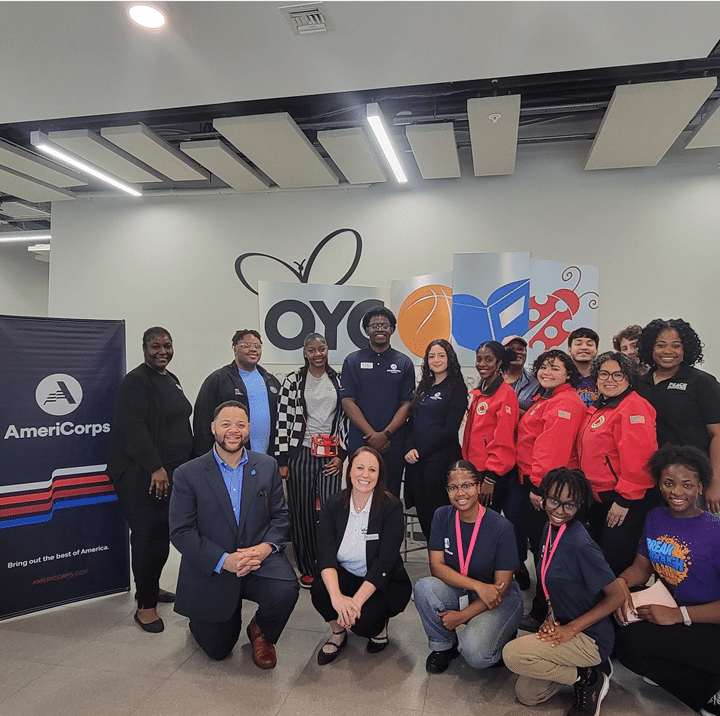
Photo Credit: Overtown Youth Center (link)
Overtown Youth Center deploys AmeriCorps members to support K-12 youth in career readiness, workforce employability, and financial literacy through its Inspire. Engage. Employ. program, operating at the Overtown Youth Center and Booker T. Washington Senior High School in Miami.
What this can look like at scale
Organizations elsewhere in the country show what is possible when college access networks build AmeriCorps programs deliberately. Michigan College Access Network runs two programs: AdviseMI places college graduates as advisers in high schools with low college-going rates, and College Completion Corps embeds completion coaches on college campuses to support students facing the greatest barriers to finishing. College Possible, which operates nationally, uses AmeriCorps members to deliver near-peer coaching to first-generation and Pell-eligible students on partner campuses.
Florida has the infrastructure and the need to do more of this. FCAN’s network of 19 local college access networks represents more than 1,000 organizations and approximately 85% of Florida’s population. AmeriCorps could be a meaningful resource for more of them.
A note on current federal developments
AmeriCorps faced significant disruptions in 2025, including the termination of nearly $400 million in grant funding in April. Federal court orders resulted in the restoration of funds, and as of early 2026, AmeriCorps programs and grant cycles remain active. FCAN will continue to monitor developments.
For a full overview of AmeriCorps programs, funding structures, and Florida data, read AmeriCorps in Florida: An Overview.