This network trains the skilled workers the nation’s fourth-largest economy needs. By 2031, 64% of jobs in Florida will require a postsecondary degree or credential, according to Georgetown University’s Center on Education and the Workforce. How well is this system positioned to serve students at every level of postsecondary attainment and meet employers’ talent needs?
FCAN’s new analysis examines the statewide agreements that let students apply credits from a career certificate or an Applied Technology Diploma (ATD) toward an associate degree. Twenty-three career certificate programs and six ATD programs articulate to 19 associate degree programs at Florida’s 28 state colleges.
These students hold a unique position. Their programs prepare them to go straight to work, and they keep a path to a degree if they enroll in a related associate program.
Workforce Pell Raises the Stakes
That path matters more this year. Workforce Pell, which extends federal Pell Grants to short-term programs of 150 to 600 clock hours, begins in Florida in the 2026-27 academic year. Only three of the 109 Florida programs eligible for Workforce Pell are in a statewide articulation agreement: firefighter, emergency medical technician and correctional officer.
Workforce Pell-eligible programs in Florida that are in a statewide articulation agreement
Source: FCAN analysis of the Florida Department of Education Workforce Pell list
Dane Shelton, FCAN research analyst, walks through findings from our new career pathways report.
The Florida Legislature’s Office of Program Policy Analysis and Government Accountability found in 2023 that few students use these pathways. Only 12% of students with a first credential enrolled in the related second credential within three years, and under 6% completed it. The office cited low awareness and uneven local availability among the reasons.
Where Are Pathways Available?
FCAN’s analysis confirms the availability gap. Figure 1 below shows where first credentials with a statewide agreement are offered in each state college service region.
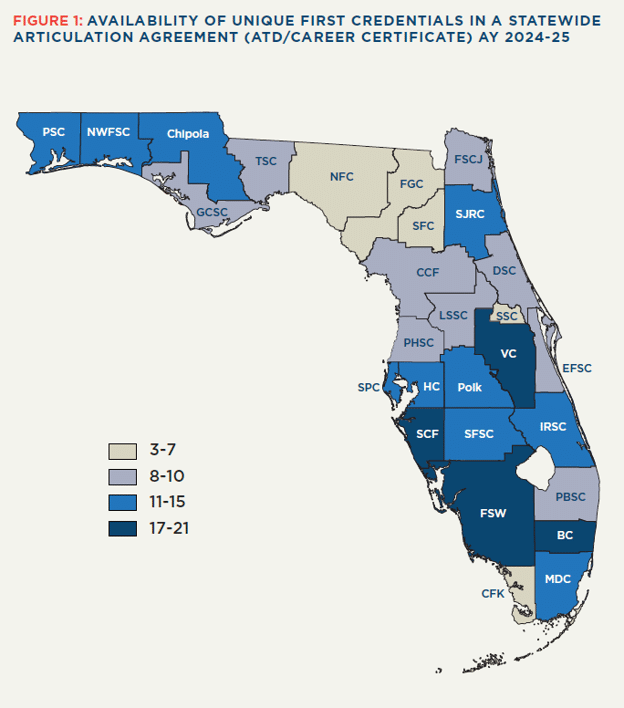
Figure 2 shows complete pathways, where both the first credential and the related associate degree are offered in the same state college region. Central and South Florida have the most options, and North Florida has notably few. Students in Broward College’s service region have 20 complete pathways available. In North Florida College’s region, they have three.
